




Stichting Humanitas
CO2 reduced
Challenge
From promise to proof
Sustainers helps organisations turn small, practical actions into measurable CO2 and business impact. Step by step, change becomes part of how work is done.
Get in touchChanging together. Less waste and CO₂: with Swash and the Sustainers app, we make working sustainably easy and fun.
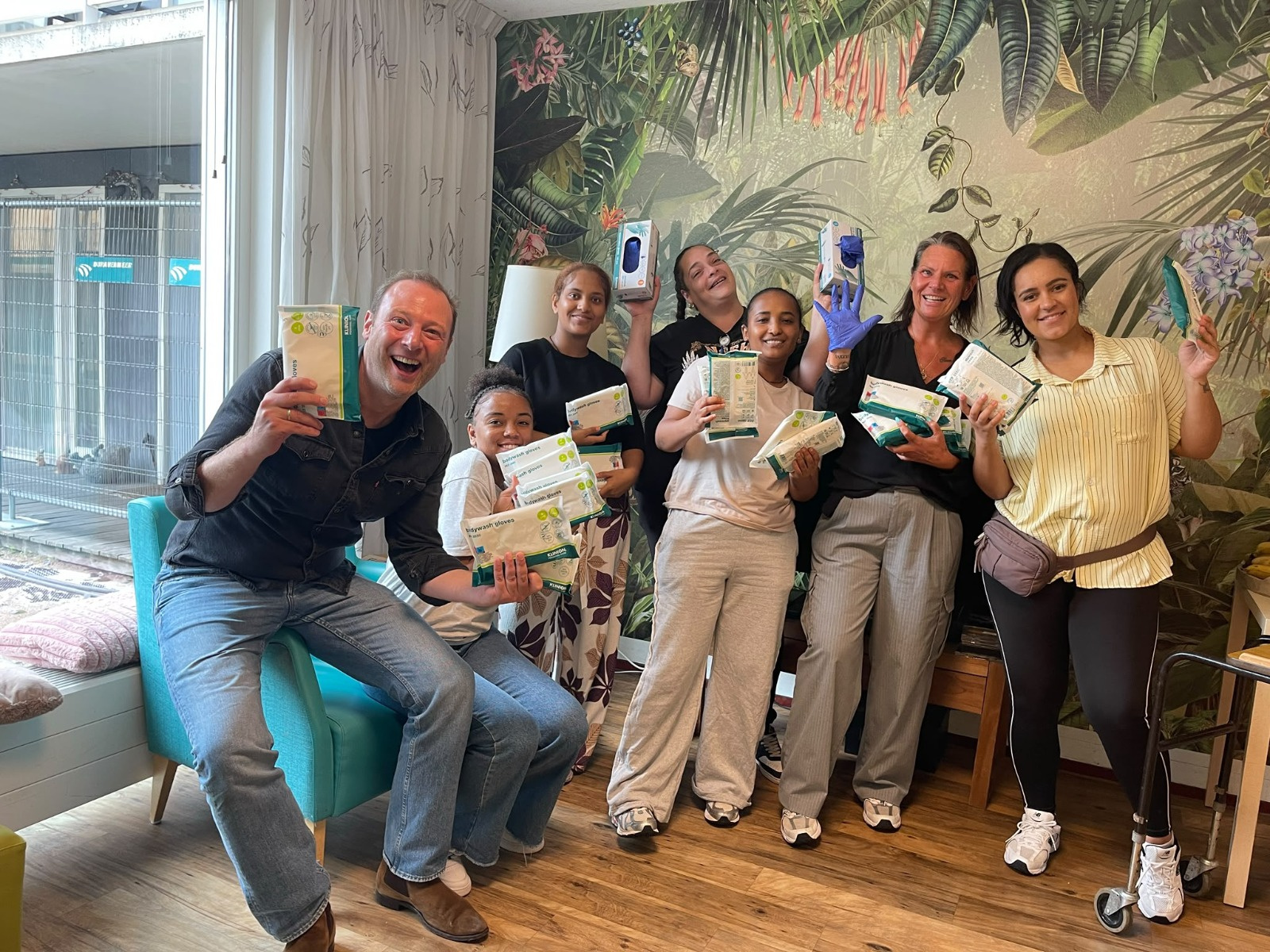
On average 300 fewer gloves per week. That is how many gloves the team at De Kristal care home in Rotterdam left unused, for four weeks, at a location with 21 residents. On top of that, the team washed residents 263 times with a warm wash glove. Staff noticed something else: “That glove also creates a kind of distance between carer and client.”
Sustainers helps care teams build small sustainable habits on the work floor. Staff check in on the app with what they do differently and see as a team what it delivers in euros, CO₂ and waste. "Start small, then make it big", says Bob van der Putten, implementation manager at Sustainers. The De Kristal team had already looked into washing more sustainably. Swash is more sustainable than a bowl of water and a towel, and it saves staff time.
The approach: the team at the wheel
From 14 September to 12 October 2026, the team followed two learning journeys. Bed bathing with Swash complements the shower: for residents in bed, as a quick freshen-up or after an accident. With No Risk, No Glove, staff leave the glove off where it is not needed. For contact with body fluids, wound care and isolation, the glove stays on, in line with the guideline.
The team decided for itself where gloves do and do not belong. It turned the general assignment into a list of its own situations, such as dressing, making beds and combing hair. "You build support when people get to make their own choice", says Bob.
Four choices made the rollout strong:
- One team. Staff moved between the two living rooms, so the whole location took part together.
- Captains from the team. Two colleagues kept up the pace and the learning journey came back in every daily huddle.
- Visible every week. Bob and the captains reviewed the numbers together weekly. The leaderboard was posted on the ward every week. "When a friendly competition comes alive, you get each other moving and build a new habit together", says Bob.
- Their own phone. The plan was a fixed laptop as a kiosk. A colleague found out the app also worked on her phone and set it up for everyone. Most of the team was on board within a week, and 80% checked in regularly on their own phone.
"It was great to take part, and I am proud of how my team took this on together." Jolanda Morf, team leader De Kristal
Participation and savings grew almost every week, right up to the last one. We rarely see growth that keeps going like that. It shows the new behaviour is becoming normal and the team applies it more and more. Staff even logged what they did during night shifts. One colleague started an extra learning journey on her own initiative, to use fewer disposable cups.
The results
"Within a week the whole ward was on the app and building new habits had begun." Nicola Zannis, senior advisor Sustainability, Stichting Humanitas
In four weeks, staff recorded themselves:
- 86% participation
- 1,200 fewer gloves
- 263 bed baths with Swash
- 15 bronze, 8 silver and 6 gold medals
- 93 kg less CO₂ and 15 kg less waste
If the team keeps up these habits, we estimate 800 kg of CO₂, 130 kg of waste and 9,800 gloves less per year for De Kristal alone.
The team saw it in the storeroom too. "It is still full", says a colleague. "So no new gloves ordered."
Residents noticed as well. Residents in bed find a warm wash glove pleasant, and there is no need to dry off. Residents who would rather not be washed sometimes accept a warm wash glove more easily. The team also pointed out that residents enjoy skin contact.
What we learned
Some staff worried that residents would be cared for "less kindly" with a wash glove, and some families reacted negatively at first. The team called families personally and involved them in the change. That worked better than a letter. Residents liked being asked for their opinion, and in the end also responded positively to the wash gloves. Agency staff did not check in, because for a single shift it was too much effort. Anyone who wants to roll this out more widely should involve policy, the works council and the client council, and make sure each location has a strong manager.
What this could mean for Humanitas
One glove or one wash bowl seems small. The strength is in numbers: when all colleagues at all locations do this together and for the long term, those small choices add up to big savings. If all Humanitas care homes take part, we estimate per year*:
- Fewer gloves: € 7,300, 6.4 tonnes of CO₂ and 340 hours of time
- Fewer Swash wash gloves: € 21,100 and 4.7 tonnes of CO₂
- Bed bathing instead of showering: € 13,800, 5.2 tonnes of CO₂ and over 4,500 hours of time
On top of that come the gains for residents: more comfort and more skin contact.
What comes next
At the end of October the team wrapped up the learning journeys. From 17 to 25 October 2026, the De Kristal story was on show at Dutch Design Week, in the exhibition Gezonde Spanning. De Kristal is keen to continue and already has many ideas for new learning journeys. Sustainers is proposing an annual plan to Humanitas to roll out the approach at scale across the organisation.
It all adds up.
* Estimate from the Sustainers Impact Potential Scan for Humanitas (26 October 2026).